7,500 TEU Container Vessel — Central Cooling Pipe
Client /A major international container-ship operator
Location / Asia-Pacific yard (confidential)
Date / 2023–2024
⚓ Container-vessel central cooling pipe · pipe-renewal project
Project Background
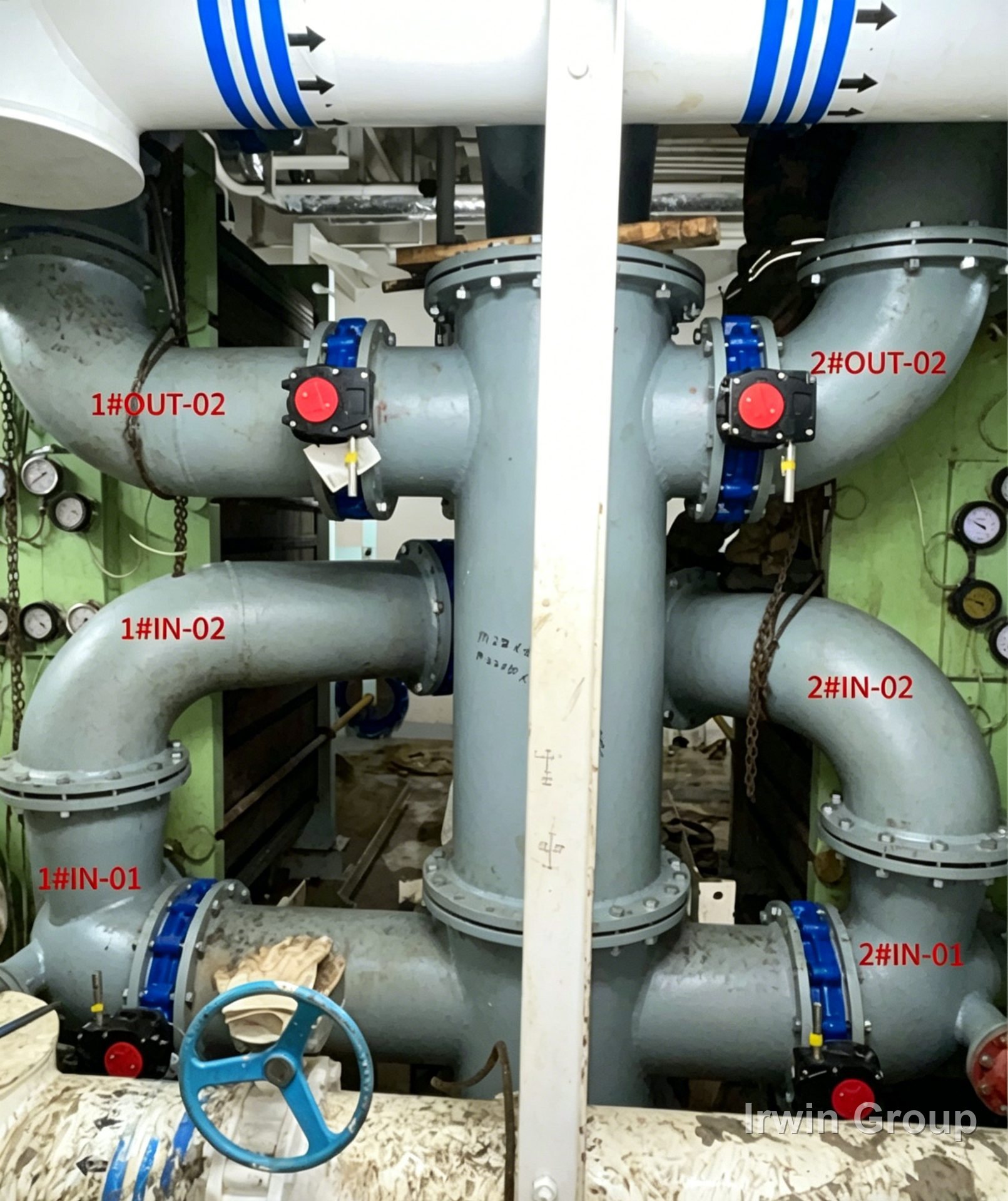
A 7,500 TEU container vessel from a major international operator needed its seawater cooling system renewed, covering the critical cooling lines of the central-cooling module. After years in a high-salinity, high-humidity marine environment, the original pipework had developed serious internal corrosion and leaks — a direct threat to safe operation. The operator searched worldwide for a supplier of highly corrosion-resistant, high-precision prefabricated pipe to replace the traditional on-site fabrication approach.
With the container vessel's schedule tightly booked, the pipe replacement had to be completed within a fixed drydock window — any delay would be hugely costly. That demanded not only excellent product quality but also precise remote-survey capability and reliable global logistics.
Challenges & Requirements
The project faced three core challenges:
Complex geometry & demanding accuracy
The pipework was geometrically complex, with many non-standard elbows, tees and reducers; copying the old pipe the traditional way was slow and could not guarantee accuracy.
Distorted old pipe, impossible to survey directly
The old pipe was so corroded, with some joints distorted, that it could not serve as a physical template for direct measurement.
Cross-continent, hot-work-free, zero-error assembly
The project spanned three continents — survey on board, manufacture in China, installation in Asia-Pacific — with no hot work possible on site.
The client was explicit: the new pipe had to achieve100% prefabrication, fit-on-arrival and zero on-site modification, at a competitive cost.
The Irwin Solution
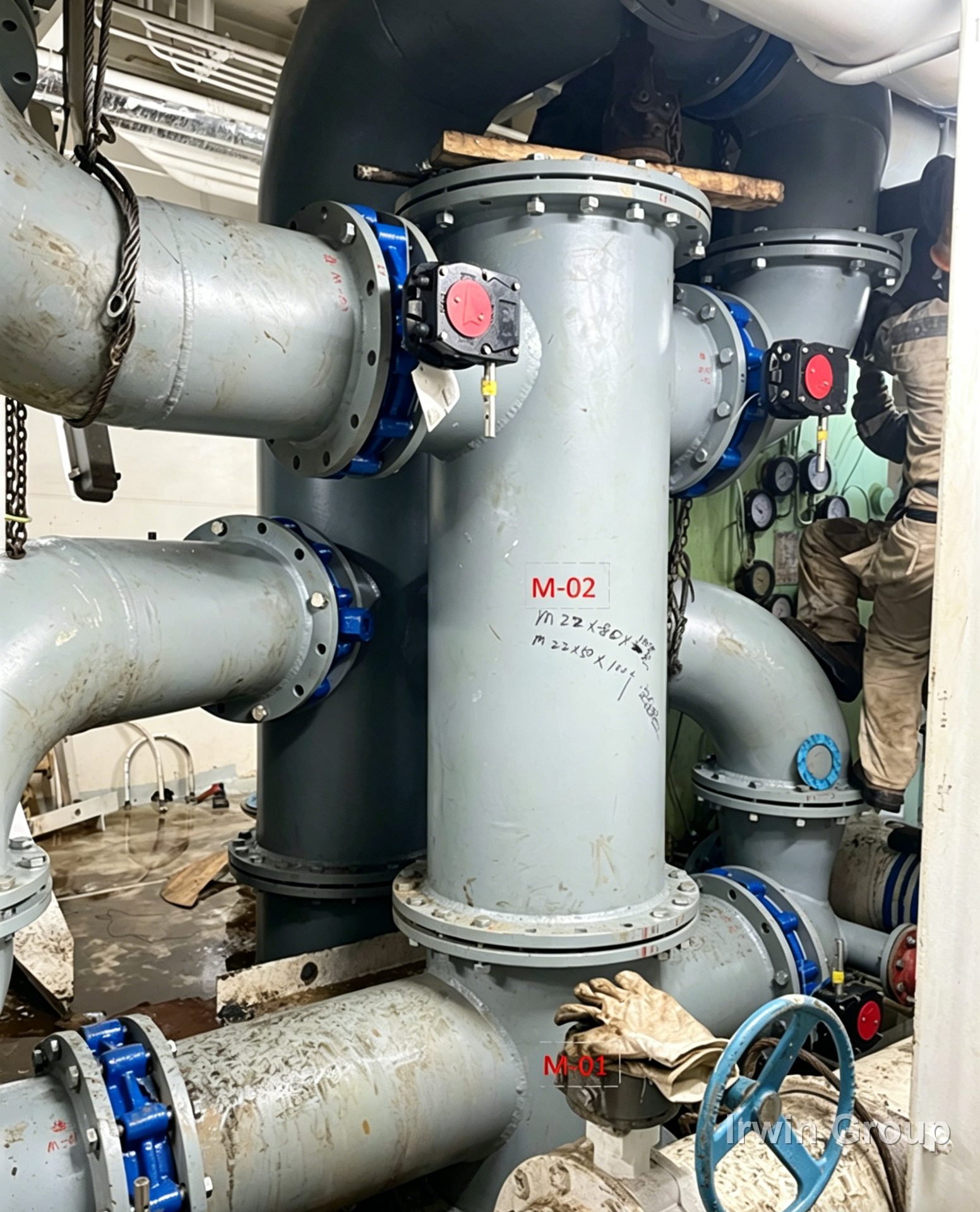
To meet these challenges, the Irwin team devised an integrated"digital survey + centralised prefabrication + global delivery"approach. First, Irwin technicians used the Automet® digital survey system aboard the container vessel to make a high-precision 3D scan of the in-service pipe, capturing as-built dimensions for every spool without removing the old pipe or relying on original drawings.
The survey data was sent in real time to the engineering centre at the Shenzhen factory, where the team turned it into an accurate 3D digital model and manufacturing isometrics. The workshop then cut, rotary-welded and assembled the spools to the digital model, with strict post-weld dimensional verification. Every spool was internally lined with rotary PE for fully sealed corrosion protection, and externally blasted and industrially coated.
Finally, all 32 prefabricated spools were independently inspected and pressure-tested, then packed and shipped by sea to the Asia-Pacific yard. The whole process closed the loop from digital model to physical product, eliminating on-site measurement, cutting and welding entirely.
Process
The full project workflow:
Results
All 32 spools fitted first time, flanges perfectly aligned, with no on-site trimming
Versus a local Asia-Pacific yard, total procurement cost fell by about 55%
From on-board survey to delivery in Asia-Pacific, fully meeting the drydock plan with zero delay
5-year drydock-to-drydock warranty, with PE lining expected to last over 15 years
✅ 100% first-time fit — all 32 spools with flanges perfectly aligned.
✅ Major cost saving — total procurement cost reduced by about 55%.
✅ Schedule matched precisely — 5-day global delivery, zero delay.
✅ Lasting quality — 5-year drydock warranty, with PE lining designed to last over 15 years.
Client Value
Through this project the client gained a piping system exceeding new-build standards at far below local-yard cost — and, more importantly, experienced a wholly new maintenance model:"digital survey, remote prefabrication, global delivery". This breaks free of the quality swings and schedule risk that come with traditional repair's reliance on manual on-site work and old-pipe copying, setting a repeatable benchmark for the fleet's later pipe projects.